The Prototype Does Not Need to Look Finished
A rough prototype helps you test one design question at a time, spot useful changes early and avoid polishing features that have not yet proved their purpose.
Your first paper sleeve for a handmade soap bar keeps splitting at the fold. That is useful information, even if the sleeve is held together with masking tape and drawn in felt tip. A prototype does not need to look finished; it needs to make a question visible enough to answer.
For a small creative project, the useful question might be whether the sleeve folds around the bar, whether a paper handle carries a small object, or whether a painted shape can be recognised from across a room. A rough model lets you examine one of these things before you spend time refining the rest. Its appearance is secondary to the behaviour you are trying to observe.
What should this prototype answer?
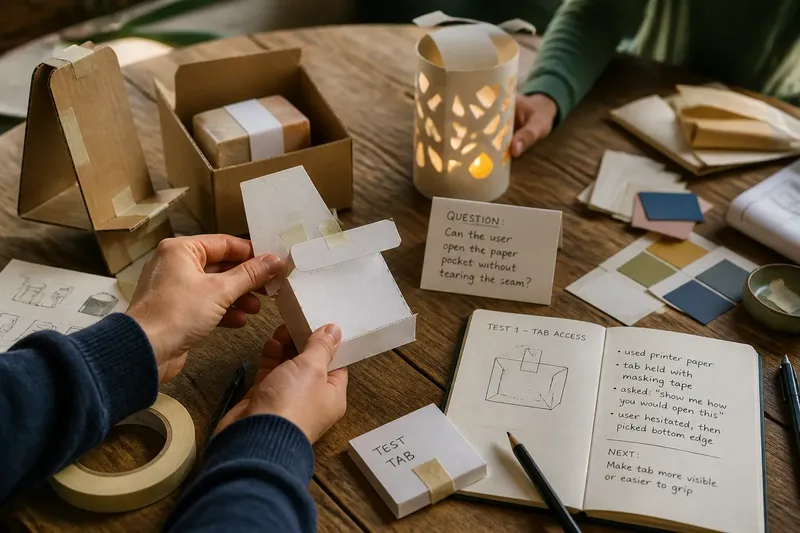
Choose a question that could change what you make next. “Does this feel nice?” is too broad to guide a decision. “Can I open this paper pocket without tearing the glued seam?” points towards an observable action and a specific part to examine.
Write the question on a scrap of card and put it beside the model. That small note keeps the session focused when attractive details tempt you into adding decoration. If you cannot say what decision the answer will inform, pause before making the model. You may need a clearer question, not more materials.
Useful questions often concern a single feature:
- Fit: Does the clay token sit inside the card recess without catching?
- Reach: Can the intended reader press the paper tab easily?
- Visibility: Can someone distinguish the two painted symbols at a glance?
- Sequence: Is it clear which flap to open first?
- Connection: Does the folded paper joint stay in place while the object is handled?
These questions are deliberately narrow. A model might reveal that the tab is easy to press but hard to see. Keep those observations separate: one answer does not settle the other.
How rough can a useful model be?
Rough enough to make quickly, but clear enough to test the chosen feature. If you are checking the size of a cardboard stand, cut a plain shape from an old cereal box. You need the fold and support surface, not a painted finish. If you are checking a colour combination, use swatches of the actual colours; a beautifully built frame would add little to that test.
Borrow materials from the finished object only where their properties matter. Ordinary printer paper can stand in for a paper label’s layout, but it will not tell you how thick card behaves at a crease. A scrap of the intended card may answer that question without requiring a complete, polished sample.
Mark temporary parts plainly. Use pencil for a fold line, masking tape for a removable join, and a note such as “test tab” where a feature is not final. These signs help you and any collaborator tell a working decision from a decorative choice. They also make it easier to change the model without feeling that you have spoiled a finished piece.
Why test one question at a time?
When a rough model fails in several ways at once, the cause becomes hard to identify. A paper stand might lean because its base is too narrow, its fold is misplaced, or its display card is too heavy. Changing all three features together may produce a better-looking result, but it will not tell you which change mattered.
Hold the other features steady where practical. If the question concerns the base width, keep the material, fold and card position the same while you compare two base shapes. This is not a formal experiment; it is a useful way to make observations easier to interpret. If several things must change, record them so you know what the next version actually tests.
Imagine you are making a small paper lantern and want to know whether its cut-out pattern reads clearly. Make a plain cylinder from the intended paper, cut one sample window, and place a battery-powered tea light behind it in a suitable setting. If the shape disappears, enlarge or simplify that window for the next model; leave the handle and decoration alone for now. You have learned about the pattern’s visibility without spending time finishing the lantern.
What should you watch while someone uses it?
For a model involving another person, give a short, neutral prompt and watch what happens before explaining the intended use. “Show me how you would open this” is more revealing than “Can you find the tab?” The second prompt points towards the answer and can hide a confusing design.
Notice pauses, repeated attempts, unexpected grips and questions. These are not verdicts on the person using the model. They are clues about what the object communicates. If the person picks up the wrong edge, the visual distinction may be weak; if they find the edge but cannot lift it, the tab may be too small or too flush with the surface.
Ask one follow-up question after the action, such as “What did you expect this part to do?” Avoid explaining the design before listening. A person’s interpretation may expose a gap between what you intended and what the model actually signals. For work with children, access needs or sensitive subject matter, choose a participant and setting with care, and avoid asking someone to handle anything that could cause harm.
What do makers usually ask about prototypes?
Should I use the same materials as the finished piece?
Use the intended material when its weight, stiffness, texture or surface changes the answer. For layout, spacing or rough proportions, a substitute such as scrap card can be quicker and entirely adequate.
How many versions should I make?
Make another version when an observation points to a change worth checking. You do not need a fixed number; stop when the question has a useful answer or when a different question becomes more important.
Can a sketch count as a prototype?
Yes, if the sketch lets you inspect the feature in question, such as the order of panels or the spacing of labels. If the question concerns folding, handling or balance, make a physical model because a drawing cannot show those actions.
When should I start making it presentable?
Begin finishing when the features that matter to your intended use have been checked well enough to guide the next version. A presentable sample can still be a prototype, but finish should serve its purpose rather than conceal an unresolved question.
How can you keep observations useful?
Keep a small record beside the model: the question, what you changed, what you saw, and what you will try next. A notebook margin or a label attached with masking tape is enough. Use plain descriptions such as “the flap catches on the corner” rather than “the design feels wrong”. The first gives you a place to act; the second needs another question before it can help.
Photographs can preserve a version before you alter it. Put a pencil or another familiar object beside the model if scale is hard to read, and include a close view of the feature under discussion. Name the image with the question or version, not “final”. This makes comparison easier when several small models accumulate on a workbench.
For a shared project, invite each collaborator to note what they saw before discussing solutions. One person may notice that the object is difficult to hold while another sees that its opening is hard to locate. Record both observations, then choose which question to test next. Agreement on a favourite colour can wait if the basic form still does not work for its intended task.
When is a rough model ready to change?
Change it when the observation has served its purpose, when the model cannot show the feature clearly, or when the next question calls for a different form. Do not preserve a weak version merely because you have spent time on it. A cut-out section, a fresh fold or a second sample can be more informative than patching every flaw into the first model.
There is also no need to keep every version. Retain the ones that explain a decision, and mark what each one taught you. If a model contains a useful dimension or connection, note that before dismantling it. The aim is not to build an archive of rough objects; it is to carry the learning into the next workable version.
Keep the prototype modest enough that you can change it without hesitation. When the model can answer one clear question, its roughness is not a weakness: it is what lets the next decision remain open.