From Sketchbook Margins to the Pocket Notebook
Pocket notebook creative ideas stay useful when quick sketches and scraps of thought remain an informal record, separate from polished project plans.
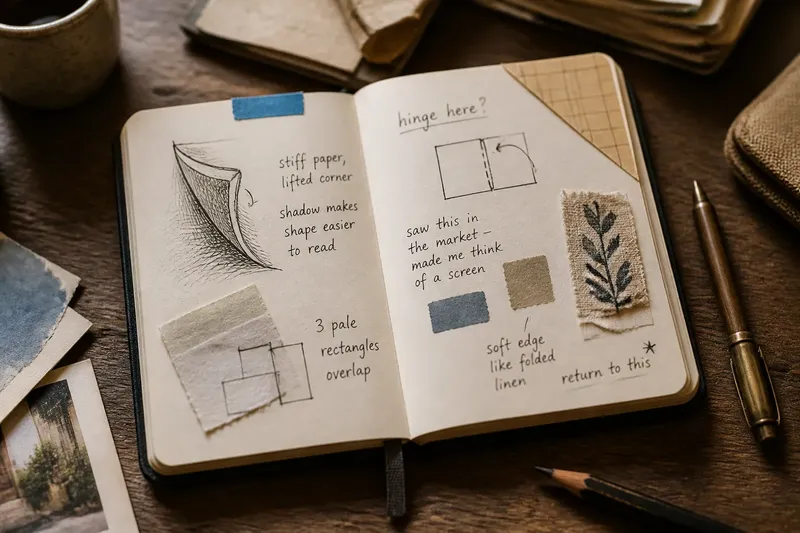
A strip of blue paper, a bent corner and the words “hinge here?” can preserve an idea that would vanish before you reach the studio. A pocket notebook for creative ideas is not a miniature project plan. It is a portable record of what caught your attention, what you wondered about and what you might want to revisit.
That distinction matters. A plan is meant to direct work; a notebook can hold uncertainty without resolving it. Its pages may contain a rough drawing, a phrase overheard in a café, a material note or a question with no answer yet. The record becomes useful not because every entry is complete, but because it keeps a thought available for later.
What belongs in a pocket notebook?
Think of the notebook as a place for observations and possibilities, rather than commitments. A sketch can show the shape of an idea before you know what it is for. A few words can capture the quality you want—“soft edge”, “like folded linen”, “too tidy”—without specifying a task or deadline.
Entries can be visual, verbal or both. Try a thumbnail sketch beside a note about scale, or paste in a small paper scrap and mark what drew your eye to it. If you are outside, record the setting as well: a window display, a bus shelter or a tree-lined path may explain why a colour or arrangement caught your attention.
Keep observations distinct from interpretations where you can. “Three pale rectangles overlap” describes what you see; “looks like a quiet room” records your response. Both can be useful, but separating them makes it easier to recognise which part of the entry was observed and which part came from your imagination.
Why keep informal records separate from plans?
Plans ask for choices. They often need an intended outcome, materials, responsibilities or an order of work. Informal notes do not have to carry those duties. They let an idea remain incomplete while you gather more impressions or wait until its relevance becomes clear.
Mixing the two can make a notebook feel like a task list that has gone wrong. A loose question may appear beside an urgent action, and the reader—often your future self—cannot tell whether it is an instruction or a passing thought. Keeping the notebook exploratory protects its function. When an idea is ready to become a project, you can transfer only the parts that deserve a decision.
This is not a demand for a separate book for every kind of thinking. One notebook can contain rough notes and a clearly marked planning page. The useful boundary is conceptual: a thought is not a promise, and a sketch is not automatically a specification.
How can you record an idea while it is still forming?
Capture enough context to make the entry recognisable later. A single shape with no note may be hard to interpret after a week; a drawing with “saw this in the market, made me think of a screen” gives your future self a route back to the moment. You need not write a diary entry. A few grounding details are often enough.
Choose marks that suit the thought. Use arrows to show movement, a small box to indicate a boundary, or a pair of swatches to compare tones. If you do not know the right word, write a rough description rather than stopping to search for a precise term. The notebook is there to catch the idea, not to grade your drawing or vocabulary.
Say you are waiting for a train and notice the way a paper ticket curls at one edge. You sketch the curl, add “stiff paper, lifted corner” and note that the shadow makes the shape easier to read. Later, you may decide the observation belongs in a collage idea, a folded-card experiment or nowhere at all. The entry has done its job by preserving a concrete detail and the reason you noticed it, without deciding what it must become.
What makes an entry easy to find again?
A notebook becomes a record through retrieval, not merely accumulation. Give entries small clues that help you locate them without imposing a heavy filing system. The date, place, subject or a distinctive word can all work. If a page contains several unrelated notes, add a short label beside each rather than trying to make the page look orderly.
Leave some physical room around sketches. A small margin lets you add a later question, a colour name or a note that changes your interpretation. You can use a pencil for tentative marks and a pen for words you want to remain legible, but there is no need to enforce a uniform code. Choose materials that are comfortable to carry and that suit the way you make marks.
When an entry begins to matter, add a simple sign: a star, a bracket or “return to this”. Use the same mark consistently enough that it means something, but do not turn it into a scoring system. Its purpose is to make a promising page easier to find, not to rank every thought.
How should a notebook record change over time?
Ideas often shift as you encounter new materials, places and conversations. Rather than erasing the old note, add a dated comment nearby or draw a line to the revised sketch. The earlier version records what you thought then; the later addition shows how the idea moved. That sequence can be more informative than a clean page that hides the uncertainty.
It can help to write down what changed your mind. Perhaps a colour felt too sharp after you saw it in daylight, or a shape reminded you of something unrelated. A short note such as “less rigid after seeing the fabric drape” preserves the connection. You are recording the path of attention, not building a case that every early thought was correct.
For a shared project, be clear about what kind of note you are making. “Possible: use a paper hinge” leaves room for discussion; “Use a paper hinge” reads as a decision. If someone else contributes a thought, note their name or initials with their permission so the source is not lost. This small courtesy helps keep an informal record useful without making it look like a finished agreement.
Which notebook should you carry, and what should you write?
Is a small notebook better than a sketchbook?
A small notebook is easier to carry, while a larger sketchbook gives your hand more room. Choose the format you are likely to have with you when ideas arrive, and consider whether its paper suits your usual pen or pencil.
Should you use a phone instead of paper?
A phone is handy for photographs, voice notes and searchable text; paper is often quicker for drawing beside a phrase. You can use both, but add a few words to a photograph so its subject and your reason for saving it remain clear.
What if you cannot draw well?
Use shapes, arrows, labels or a quick map of where things sit. A rough sketch is a reminder to yourself, not a presentation, and a few precise words can make it clearer than polished linework.
When should a note become a project plan?
Move it when you can state what you want to make or explore and are ready to choose a next action. Until then, let the notebook hold the question without treating it as unfinished work.
How do you stop the notebook becoming another obligation?
Do not require a daily entry or a tidy page. Some stretches will contain several notes; others may have none. If you review the book, do so with a light purpose: look for a mark you want to revisit, a recurring material or an unresolved question. You do not need to convert every page into a task.
A simple routine can help without taking over. When you start a new project, flip through a few recent pages and mark anything that genuinely connects. When you finish, add a note about what the original idea became, if anything. That closes a small loop while leaving unrelated observations alone.
Protect the notebook from becoming a storehouse of obligations by distinguishing “interesting” from “must do”. A question mark, a tentative phrase or a label such as “maybe” can preserve that difference. If you later choose to act, bring the idea into a separate plan and make the necessary decisions there.
The pocket notebook earns its place by keeping unfinished thoughts accessible, not by turning them all into projects. When you return to a page, the useful detail may be the sketch, the setting or the question in the margin. Keep enough context to recognise why it mattered, and let the rest remain open. That is what makes a pocket notebook for creative ideas a record rather than a miniature plan.